FRONTLINE Youth Mental Health Training & Consulting
Evidence-informed, interactive training designed specifically for professionals who work with youth in residential care, shelters, outreach programs and community settings.
About FRONTLINE
Built from experience on both sides of frontline youth care.
FRONTLINE was developed by Curtis Romance, a Registered Nurse specializing in child and adolescent mental health, with more than a decade of experience supporting young people and families.As a former youth care worker and now working in psychiatric emergency care, Curtis has seen firsthand the challenges staff face when supporting young people with increasingly complex mental health and behavioural needs.
FRONTLINE was created to help bridge that gap
— bringing clinical knowledge and frontline experience together in a practical training designed for the realities of youth care.
.

Who is FRONTLINE for?
Designed for professionals supporting young people with complex needs in Manitoba.
✓ Youth Care Workers
✓ Residential Care Staff
✓ Community-Based Youth Organizations
✓ Foster Care Teams
✓ Mental Health Support Staff
✓ Supervisors & Team Leaders
The Training
Four modules. One practical approach.
6-hours, interactive training experience that connects an understanding of youth behaviour and mental health with the practical skills staff need in their everyday work.
Module 1
Understanding Youth in Care
Trauma, behaviour, the developing brain, and what may be happening beneath the behaviours.
Key themes:
Behaviour as communication ● Trauma & the brain ● The BRIDGE Model™ ● Connection before correction
Module 2
Mental Health, Emotional Regulation and Behaviour
Recognizing mental health needs and helping young people regulate through difficult moments.
Key themes:
Mental health & behaviour ● Emotional regulation ● Common mental health concerns ● Recognizing changes ● Supporting youth in everyday care
Module 3
Therapeutic Communication and De-escalation
Practical communication strategies for reducing conflict, responding to escalation, and repairing the relationship after a difficult interaction.
Key themes:
Therapeutic communication ● Validation ● Recognizing escalation ● De-escalation ● Relationship repair
Module 4
Accountability, Boundaries and Staff Wellness for the Long-Term
Balancing compassion with accountability, maintaining healthy boundaries, and supporting long term staff wellness.
Key themes:
Accountability ● Healthy boundaries ● Consistency & expectations ● Burnout & compassion fatigue ● Wellness for the long-term
Built for the realities of frontline work.
Bring practical, evidence-informed training to your team and give staff tools they can use on their very next shift.
Why Frontline?
Working with youth is complex.
Staff are expected to build relationships, respond to challenging behaviour, support young people through difficult moments, set boundaries and make good decisions - sometimes all in the same shift.FRONTLINE was created around that reality. The training helps staff better understand what may be behind a young person's behaviour and gives them practical ways to respond while maintaining connection, safety and accountability.
Pricing
Introductory pricing in effect until the end of March 2027
Practical training.
Straightforward pricing.
Up to 15 People
$1,295
per training session
16-25 People
$1,595
per training session
26-35 People
$1,895
per training session
Bring FRONTLINE to your team
Ready to strengthen your team's confidence in supporting young people with complex mental health and behavioral needs?
FRONTLINE training can be delivered directly to your organization. Get in touch to discuss your team, preferred training dates, group size, or any questions about the program.
Consultation
Sometimes training is only the beginning
Frontline is developing consultation services for organizations supporting youth with complex mental health, behavioral and emotional needs.Consultation may include support with individualized care planning, understanding challenging behaviour, strengthening staff approaches, identifying patterns and triggers, and developing practical strategies that can be used consistently across a care team.The focus is not on diagnosing youth, but on helping the adults around them understand what may be happening and determine practical, compassionate and accountable ways forward.Have a situation your team is struggling with?
Contact Frontline to discuss whether consultation may be a good fit.
Frequently Asked Questions
How long is the training?The course is a 6-hour training day, including two 10-minute breaks and a 40-minute lunch. Lunch is not provided, and participants are encouraged to bring their own meal. Light refreshments may be available throughout the day. The six-hour format was intentionally designed with the realities of frontline shift work in mind, giving organizations greater flexibility when scheduling staff who work 12-hour shifts.Where is the training delivered?Training is delivered on-site at your organization, allowing your team to learn together in their own dedicated training room or workplace setting.Do participants receive a certificate?Yes. Participants who complete the full training receive a certificate of completion.Does FRONTLINE provide the training materials?Yes, all training materials, presentation equipment required for the session will be provided. Your organization simply provides an appropriate training space, access to electrical outlets and Wi-Fi.How many people can attend?That depends on the training space. Standard Pricing accommodates groups of up to 35 participants, with larger groups available by custom price.Who is FRONTLINE designed for?FRONTLINE is designed for professionals supporting young people with complex needs, including youth care workers, residential care staff, foster care teams, mental health support teams, supervisors, team-leaders and community-based youth-serving organizations.Is FRONTLINE crisis-intervention or restraint training?No, FRONTLINE focuses on understanding behaviour, mental health and emotional regulation, therapeutic communication, de-escalation, accountability, boundaries and staff wellness. It currently does not replace an organization's required crisis-intervention or physical safety training.Are there already mental health training programs available?Yes. There are a few valuable mental health programs available. FRONTLINE is different because it was designed specifically for professionals working directly with youth who have complex mental health and behavioural needs.Rather than providing broad mental health education, FRONTLINE focuses on the realities of youth care work, understanding that youth mental health and behavioural complexities can be very different from those of adults.It brings these pieces together through a youth-focused, frontline lens.
204-202-6566
Winnipeg, Manitoba
© 2026 FRONTLINE Youth Mental Health Training & Consulting
A registered Manitoba business
Request Training Information
Interested in bringing FRONTLINE to your organization?Complete the form below and we will be in touch to discuss your teams training needs, group size and potential dates.
FRONTLINE Resource Hub
Tools for the work that happens after the training.
Welcome to your FRONTLINE Resource Hub.
This space is designed to keep the tools from your training close at hand. Explore quick-reference guides, practical strategies and resources you can return whenever you need them.
For future visits, keep your QR code handy to access FRONTLINE Resource Hub.
Quick Reference Tools
The BRIDGE MODEL™
A quick reference guide to the six principles that help connect what you see with what a young person may be communicating.
Communication & De-escalation
Practical reminders for communicating clearly, validating emotions and responding when situations begin to escalate.
After the Incident
Practical guidance for reconnecting, rebuilding trust and moving forward after a difficult or critical incident.
Staff Reset & Reflection
Practical tools to help you pause, reflect and reset after challenging interactions, while recognizing the cumulative weight of frontline work.
When More Help is Needed
Find Manitoba Crisis Resources, along with practical information about what to expect when bringing a young person to Children's Emergency for a mental health concern.
For future visits, keep your QR code handy to access FRONTLINE Resource Hub. The FRONTLINE Resource Hub will continue to grow, with new tools, practical resources and updated material added over time. Check back occasionally to see what's new.
204-202-6566
Winnipeg, Manitoba
© 2026 FRONTLINE Youth Mental Health Training & Consulting
A registered Manitoba business
The BRIDGE MODEL™
Connection before Correction. Before responding to behaviour, look beneath it.BRIDGE™ is a practical framework for slowing down our interpretation of behaviour and considering what may be happening underneath. Use it as a quick mental check when a young person's behaviour is difficult to understand or respond to.
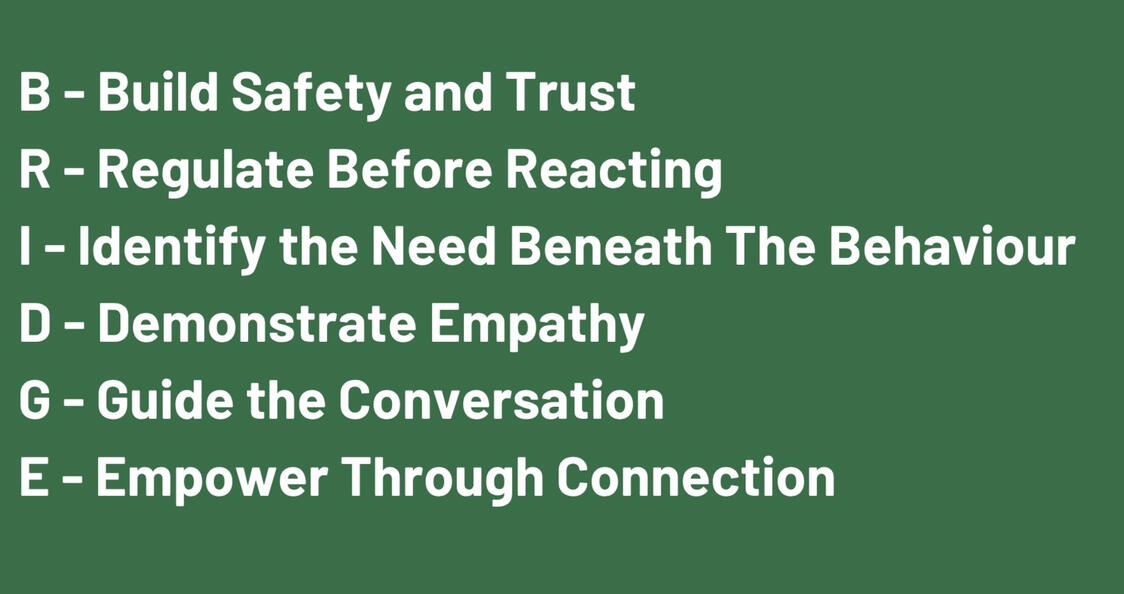
B - Build Safety and Trust
Does this young person feel physically and emotionally safe with me right now?R - Regulate Before Reacting
Am I regulated enough to respond rather than react?I - Identify the Need Beneath the Behaviour
What might this behaviour be communicating or trying to accomplish?D - Demonstrate Empathy
Can I acknowledge their experience without necessarily agreeing with the behaviour?G - Guide the Conversation
What can I say or ask that moves us toward understanding rather than confrontation?E - Empower Through Connection
How can I involve the young person in what happens next rather than simply doing it for them?When you're stuck
Don't ask only. "How do I stop this behaviour?"
Ask, "What is this behaviour telling me, and what does this young person need from me right now?"
Communication & De-escalation
The goal is not to win the conversation. It is to help bring the temperature down.
TRY THIS → INSTEAD OF THIS"Help me understand what happened."
instead of "what is wrong with you?""I can see you're angry. I'm here when you're ready."
instead of "Calm down.""We don't have to solve everything right now."
instead of "We need to talk about this right now!""You are allowed to be angry but you cannot hurt anyone or damage anything."
instead of "You cannot talk to me like that, I'm calling the police!"
When emotions are high, how we communicate matters as much as what we say. Keep your language simple, your tone steady, and your expectations realistic. Regulation and connection come before problem solving.
Before you speak, check yourself:Tone - Am I calm, or am I matching their intensity?
Volume - Am I getting louder because they're getting louder?
Pace - Am I giving them enough time to process?
Words - Am I saying more than they can take in right now?
Position - Am I giving them enough physical space?WHEN ESCALATION IS RISING ↑
Do less, not moreFewer words
Fewer demands
Fewer questions
More space
More time
More calm
After the Incident
Repair does not mean pretending nothing happened.
After an intense situation, both the young person and the staff member may carry strong emotions. Fear, anger, embarrassment, guilt, frustration or even mistrust can remain long after the incident.Repair is not about removing accountability. It is about creating enough safety to reconnect, understand what happened and decide how to move forward.BEFORE YOU RECONNECT
Ask yourself:Am I ready? Can I approach this without anger, sarcasm or needing to prove a point?
Are they ready? Has the young person had enough time and space to regulate?
Is this the right time? Not every incident needs to be processed immediately.WHEN YOU RECONNECT
Start with the relationship, not the behaviour."You had a rough night. How are you doing now?"
"I know things got pretty intense earlier. I wanted to check in."
"We don't have to figure everything out right now."TWO THINGS CAN BE TRUE
The behaviour may have been unacceptable.
The relationship can still be repaired.Supporting a young person does not mean excusing aggression, threats, property damage or other harmful behaviour. Accountability and connection can exist at the same time.CONSEQUENCES AFTER AN INCIDENT
A consequence should teach, repair or restore - not simply punish.Consequences may be appropriate after an incident but they should connect to what happened, be proportionate to the behaviour, and appropriate to the young person's developmental needs and circumstances.Before deciding on a consequence, ask:Is this related? Does the consequence make sense in relation to what happened?
Is it proportionate? Does it match the seriousness of the behaviour?
Is it achievable? Can the young person realistically complete what is being asked?
Does it repair something? Where possible, can it help restore safety, repair property damage, rebuild trust or encourage responsibility?
Will it teach anything? What do we want the young person to learn for the next time?For example:
A 14 year old damages his bedroom wall by punching a hole through it. Helping repair, clean up or contribute towards replacing the damage has a logical connection to the behaviour. Removing unrelated items like a phone or take away privileges like an outing may provide punishment but does not necessarily build responsibility.Accountability asks: "How do we make this right?"
Punishment asks: "How do we make you pay?"MOVING FORWARD
Once both of you are ready, keep the conversation simple.Understand - "What happened to you?"
Own your part If there is something you could have handled differently, acknowledge it.
Address the behaviour Be clear about what was not okay without attacking the young person.
Look ahead What could we do differently next time?
Reconnect Don't make the incident the young person's new identity. Allow the relationship to move forward.
Staff Reset & Reflection
You can care deeply about work without bringing it all home with you.
Frontline work accumulates. Sometimes it is not one major incident that weighs on us, but dozens of smaller interactions, decisions and emotions carried across a shift.Taking a few minutes to notice what you're carrying can help prevent today's experience from becoming tomorrow's weight.AFTER A DIFFICULT INTERACTION
Before moving immediately to the next task, ask yourself:What am I feeling?
Angry? Frustrated? Shaken? Guilty? Drained? Sometimes simply naming it helps.
What am I carrying?
Is there something about this interaction that I'm continuing to replay?
What is mine to own?
Was there something I could have handled differently? If so, learn from it without beating yourself up.
What isn't mine to carry?
Not every outcome is within your control.
What do I need before I can continue?
A few minutes? Water? Fresh air? A conversation with a colleague? A chance to regroup?THE END-OF-SHIFT-CHECKOUT
Before you leave your shift, take 60 seconds:One thing I handled well today:
One thing I learned today:
One thing I need to leave at work:Reflect on the shift. Learn from the shift. You don't have to keep reliving the shift.
When The Weight Starts to Build
Not everything we carry comes from one overwhelming situation. Sometimes it is the accumulation of difficult shifts, repeated conflict, responsibility, worry and exposure to other people's distress.Pay attention when you notice:
Difficulty switching off after work
Replaying interactions long after your shift
Becoming unusually impatient or detached
Dreading interactions you would normally manage
Carrying one young person's situation everywhere with you
Feeling like you have nothing left to give
Reduce your stress and ask yourself...What can I process?
What can I change?
What can I share?
What can I let go of?
Crisis & Emergency Contacts
Kids Help Phone - 24/7
Call **1-800-668-6868
Text CONNECT to 6868689-8-8 Suicide Crisis Helpline 24/7
Call or Text 9-8-8
Can also be contacted by someone who is worried about another person.The Link - 24-hour Mobile Crisis Line
Winnipeg: 204-949-4777
For youth and caregivers experiencing mental health challenges.ANCR - Child & Family Services
After hours line: 204-944-4050If there is an immediate threat to life or safety, call 9-1-1 or go to your closest emergency department.
What to Expect at Children's Emergency for a Mental Health Concern
Bringing a young person to Children's Emergency for a mental health concern can be stressful - especially when you don't know what happens next.
HSC Children's Emergency Department sees patients up to 17 years of age for mental health concerns.1. TRIAGE
When you arrive, report to the triage desk. The young person will be assessed and directed to the waiting room or to a patient-care room.
Tell staff immediately about any safety concerns, including suicide attempts, self harm, aggression, substance-use, or anything else that may affect the young person's immediate safety.2. EXPECT TO WAIT
Mental-health assessments can sometimes involve a lengthy wait. Emergency patients are seen according to medical need rather than simply in the order they arrive.
Come prepared for the possibility of several hours at the hospital. Bring snacks and something to pass the time, such as headphones for music, a book, or another quiet activity.3. THE ASSESSMENT
After triage, an Emergency Psychiatric Nurse may assess the young person, most times followed by an Emergency Department physician.
The young person and caregiver will normally be interviewed separately, giving both an opportunity to explain what has been happening. The team will work with the young person and caregiver to develop a plan that addresses the concerns and maintains safety.
For safety, the young person may also be asked to hand in belongings that could potentially be used to self-harm.4. WILL WE SEE A PSYCHIATRIST?
Not necessarily.
Coming to Children's Emergency for a mental-health concern does not automatically mean the young person will see a psychiatrist. A Psychiatric Emergency Nurse and/ or Emergency Department physician will determine whether a psychiatric consultation would be appropriate and helpful at that time.Please bring along the child's health card and any medication.